
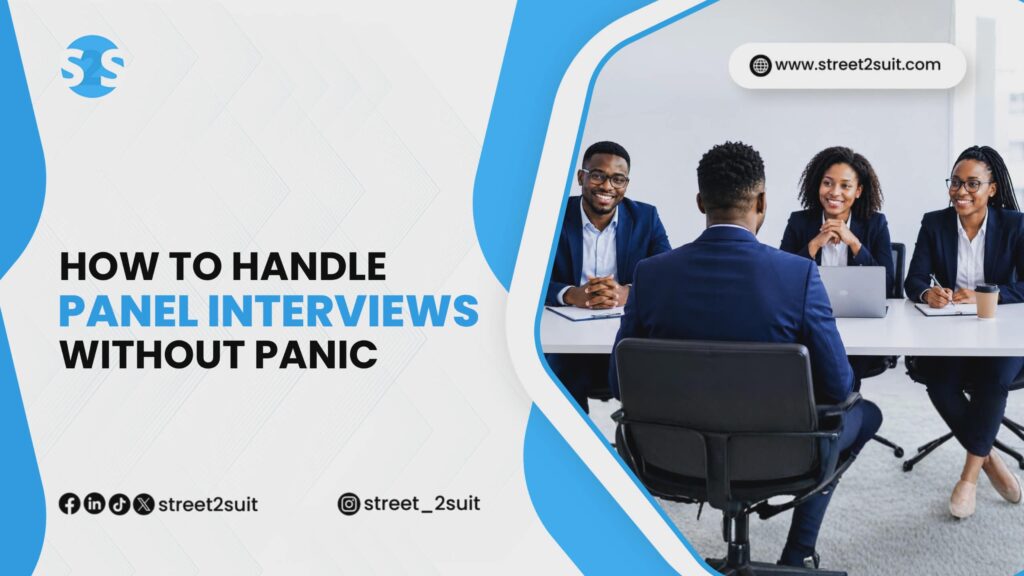
Panel interviews can feel like walking into a room where all eyes are waiting and not in a comforting way.
You are faced with multiple interviewers, multiple perspectives, and multiple expectations.
It’s easy to feel like you’re being examined from every angle at once because your heart races, your thoughts scatter, and suddenly simple questions feel harder than they should.
But here’s the truth: panel interviews are not designed to intimidate you, they are designed to save time and gather balanced opinions.
Once you understand how they work and how to approach them, they become far more manageable.
Why Panel Interviews Feel So Intimidating
The pressure comes from a few things happening at once:
- You’re trying to impress more than one person.
- You don’t know who holds the most influence.
- Different interviewers may focus on different areas.
- You feel like you’re being judged simultaneously.
This creates a sense of overload, but the key is to simplify the experience in your mind.
You’re not performing for a crowd but having a structured conversation with individuals one at a time.
Understand What Each Person Is Looking For
In most panel interviews, each interviewer has a role.
For example:
- A hiring manager may assess overall fit and experience.
- A team member may evaluate collaboration and communication.
- A technical expert may focus on skills.
- HR may look at behavior and alignment with company values.
They are not all asking the same questions mentally and understanding this helps you avoid trying to impress everyone in the same way.
Instead, focus on answering each question clearly for the person asking it while still including the rest of the panel.
Start Strong, First Impressions Matter More Here
In a panel setting, your introduction sets the tone quickly.
When you enter:
- Greet everyone confidently.
- Make brief eye contact with each person.
- If appropriate, acknowledge names.
You don’t need to be overly energetic or loud. Calm confidence works better than forced enthusiasm.
A composed start signals that you can handle pressure even if you feel nervous inside.
Answer One Person But Include Everyone
When a question is asked, it’s natural to focus on the person speaking which is good, but don’t stop there.
Use this approach:
- Start your answer by addressing the person who asked.
- Gradually include eye contact with others as you continue.
- End your response by reconnecting with the panel.
This creates inclusion and shows awareness.
Avoid locking your attention on one person the entire time, it can unintentionally exclude others.
Slow Down Because Panic Will Speed You Up
When anxiety kicks in, most people:
- Speak too quickly.
- Rush through answers.
- Lose structure.
Slowing down is one of the simplest ways to regain control. Take a brief pause before answering, breathe, then respond clearly.
A short pause does not make you look unprepared, it makes you look thoughtful.
Structure Your Answers Clearly
Panel interviews reward clarity, being in a room with multiple listeners, a scattered answer becomes harder to follow.
Use simple structures like:
- Situation + Action = Result
- Problem + Approach = Outcome
This helps:
- Keep your thoughts organized.
- Make it easier for everyone to understand you.
- Reduce the chances of rambling.
Clear answers stand out more than long ones.
Don’t Panic If You Don’t Know Something
You may get a question you’re unsure about which is normal, especially with multiple interviewers bringing different perspectives.
Instead of panicking:
- Acknowledge the question.
- Share what you do know.
- Explain how you would approach finding the answer.
For example:
“I haven’t handled that directly, but based on my experience with… I would approach it by…”
This shows problem-solving ability, not weakness.
Handle Multiple Questions Calmly
Sometimes, panel interviews come with back-to-back or layered questions.
If that happens:
- Don’t rush to answer everything at once.
- Address one part at a time.
- If needed, clarify by saying “I’ll start with the first part of your question…”
Breaking questions down reduces pressure and improves clarity.
Read the Room Without Overthinking It
In a panel, not everyone will react the same way.
Some may:
- Nod.
- Take notes.
- Stay expressionless.
Don’t assume silence means disapproval, different interviewers process information differently.
Focus on delivering your answers clearly rather than trying to interpret every facial expression.
Ask Thoughtful Questions at the End
When given the chance to ask questions, use it well.
Avoid questions that can be easily found online.
Instead, ask things like:
- How do different teams here collaborate on projects?
- What does success in this role look like across departments?
- What challenges is the team currently facing?
This shows:
- Interest
- Awareness
- Strategic thinking
It also helps you understand the role better.
Prepare for Panel Dynamics in Advance
Preparation reduces panic more than anything else.
Before the interview:
- Research the company and role.
- Prepare answers to common questions.
- Practice speaking out loud.
- If possible, learn who will be on the panel.
The more familiar the situation feels, the less overwhelming it becomes.
Reframe the Experience
Instead of thinking that you are being judged by multiple people, start thinking that you have the opportunity to show different people how you can contribute which reduces pressure from your end.
Remember, the panel are not against you, they are trying to decide if you fit the role just as you are deciding if the role fits you.
After the Interview: Reflect, Don’t Overthink
Once it’s over, it’s tempting to replay every moment, but overanalysis increases anxiety.
Instead, reflect constructively:
- What went well?
- What can improve next time?
Then let it go because every interview is practice for the next.
Conclusion
Panel interviews may feel intense, but they are manageable with the right approach.
You don’t need to impress everyone perfectly.
You need to:
- Stay calm
- Communicate clearly
- Engage the room
- Show your thinking
Panic comes from trying to control everything while confidence comes from focusing on what you can control which are your preparation, your delivery, and your mindset.
You’re not there to perform flawlessly, you’re there to show that you can handle responsibility even in a room full of eyes.
And often, that’s exactly what they’re looking for.