

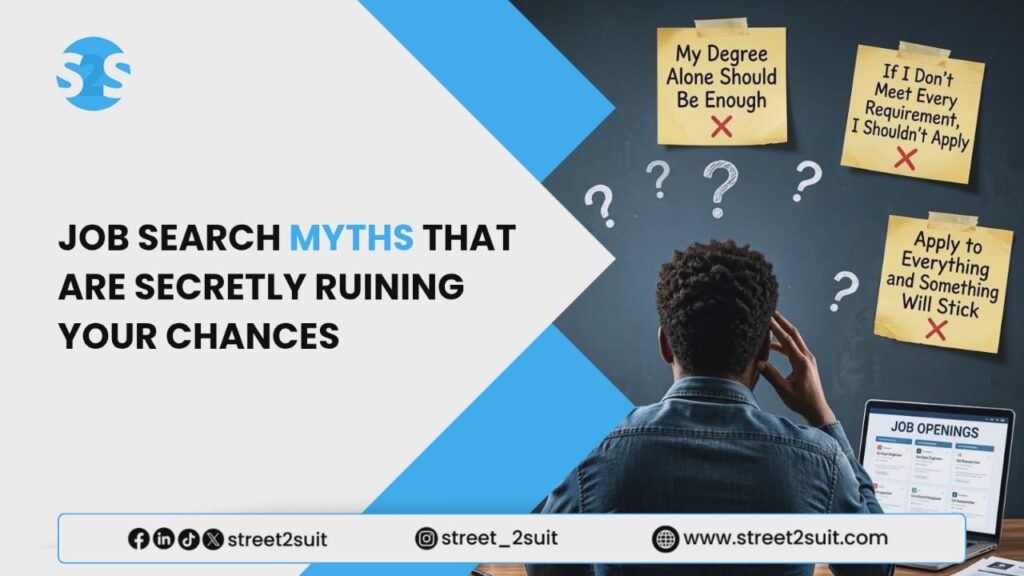
Job hunting is already stressful enough yett many job seekers carry outdated beliefs that sound wise on the surface but quietly damage their chances behind the scenes. Some of these myths come from older career eras, some come from social media while some are repeated so often that people accept them as truth without questioning them.
The result is painful: talented people remain stuck, discouraged, and confused not because they lack potential, but because they are following rules that no longer serve them.
The modern job market is competitive, fast-moving, and constantly changing. To succeed, you need strategy more than superstition.
If your applications feel ignored, interviews are rare, or progress seems slower than it should be, one or more of these myths may be working against you.
1. Apply to Everything and Something Will Stick.
This sounds productive, but it often creates weak applications.
Mass-applying to dozens or hundreds of roles with the same CV usually leads to:
- Generic applications
- Poor role alignment
- Burnout
- Low response rates
Many job seekers mistake activity for progress. Sending 100 rushed applications can be less effective than sending 15 strong, targeted ones.
A smarter approach is to:
- Focus on roles that match your skills
- Tailor your CV to the job description
- Write thoughtful applications
- Track where you apply
Quantity matters less when quality is missing.
2. If I Don’t Meet Every Requirement, I Shouldn’t Apply.
This myth eliminates good candidates before employers ever get the chance.
Job descriptions are often written as ideal wish lists, not strict checklists. Employers know they may not get someone who matches every bullet point.
If you meet a strong portion of the core requirements and can learn the rest, you may still be competitive.
Many people reject themselves because they assume “not perfect” means “not qualified.”
It doesn’t, if you reasonably fit the role, apply and let the employer decide.
3. My Degree Alone Should Be Enough.
Education matters, but degrees alone rarely guarantee opportunities.
Employers increasingly look for:
- Practical skills
- Communication ability
- Relevant experience
- Problem-solving
- Adaptability
- Evidence of initiative
A degree may open the door, but it does not automatically walk you through it.
Candidates who combine education with projects, internships, volunteering, freelancing, certifications, or portfolio work often stand out more strongly than those relying only on credentials.
4. The Best Person Always Gets the Job.
This belief creates unnecessary self-doubt after rejection.
Hiring decisions involve many factors:
- Timing
- Internal candidates
- Budget changes
- Team fit
- Communication style
- Specific experience alignment
- Urgency of need
Sometimes a strong candidate loses out simply because another candidate matched a very specific need.
Rejection does not automatically mean you were the weakest option, so do not turn every “no” into a statement about your worth.
5. Networking Means Begging People for Jobs.
Because of this myth, many capable people avoid networking entirely.
Real networking is not desperation, it is relationship-building.
It can look like:
- Reaching out to learn from someone in your field
- Asking informed questions
- Staying in touch professionally
- Sharing useful insights
- Reconnecting with former colleagues
Many jobs are filled through referrals, conversations, and visibility before public postings gain traction.
Networking done respectfully is not begging, it is a strategic connection.
6. One CV Works for Every Job.
A one-size-fits-all CV quietly weakens your chances, different employers prioritize different things. A customer service role may value communication and conflict resolution, while an operations role may care more about systems, organization, and execution.
If your CV says the same thing for every role, it may fail to highlight what matters most. Tailoring does not mean rewriting from scratch each time, it means adjusting emphasis, keywords, achievements, and relevance.
A targeted CV feels stronger because it is stronger.
7. I Need More Confidence Before I Apply
Confidence is useful, but many people wait for it like it arrives first and it doesn’t.
Confidence often comes after:
- Sending applications
- Practicing interviews
- Learning from rejection
- Taking action repeatedly
If you wait until you feel fully ready, you may wait too long. Action builds confidence more reliably than overthinking ever will.
8. Online Applications Are Enough
Many job seekers rely only on clicking “Apply.” Online applications matter, but they are only one lane.
Other lanes include:
- Recruiter outreach
- LinkedIn visibility
- Referrals
- Direct company career pages
- Professional communities
- Alumni networks
If you only use crowded job boards, you compete in the noisiest channel. Use multiple pathways.
9. Employment Gaps Automatically Disqualify Me
Many people panic over gaps and become overly apologetic.
Life happens. People pause careers for:
- Family responsibilities
- Health reasons
- Study
- Relocation
- Economic conditions
- Personal reset periods
What matters most is how you frame the gap now.
Show:
- What you learned
- How you stayed active
- Why you’re ready now
- What value you bring next
A gap is part of your timeline, not the end of it.
10. If They Want Me, They’ll See My Potential
Potential matters, but employers often need evidence because tey cannot read hidden abilities. You may know you are hardworking, intelligent, adaptable, and capable under pressure. But if your CV, portfolio, interview answers, or online presence do not communicate that, it stays invisible.
Translate potential into proof:
- Results
- Examples
- Projects
- Clear stories of impact
Potential unsupported by evidence is often overlooked.
11. Rejection Means Stop
Rejection can feel personal, but it is usually procedural, strong candidates are rejected every day.
Sometimes because:
- Too many applicants applied
- The role was frozen
- Another candidate had niche experience
- The interviewer preferred a different style
Use rejection as feedback, not prophecy. Adjust strategy, improve materials, continue moving.
12. Hard Work Alone Will Get Me Hired
Hard work matters, but invisible hard work often stays invisible.
You also need:
- Positioning
- Communication
- Strategy
- Timing
- Market awareness
- Relationship-building
Working hard privately without presenting value publicly can delay results. Merit helps most when it is visible.
What Actually Improves Your Chances
Instead of myths, focus on fundamentals:
- Target roles thoughtfully
- Tailor your CV and applications
- Build skills continuously
- Practice interviewing
- Strengthen LinkedIn presence
- Network genuinely
- Follow up professionally
- Stay consistent without burning out
Job searching is not only a test of talent, it is a test of adaptability.
Conclusion
Some of the biggest career setbacks are caused not by failure, but by false beliefs.
Myths make people:
- Wait too long
- Apply too little
- Apply too broadly
- Hide their value
- Misread rejection
- Undervalue relationships
The sooner you replace myths with strategy, the sooner progress becomes possible.
You do not need perfect luck, you need clearer thinking, stronger execution, and persistence rooted in reality because many people are not losing to competition, they are losing to advice that should have expired years ago.