At the beginning of every semester, year, or even month, we make bold declarations.
“This time, I’ll be consistent.”
“I’ll read every day.”
“I’ll save money.”
“I’ll wake up by 5am.”
Two weeks later?
The alarm is snoozed. The books are closed. The goal is now a motivational quote in your notes app. The problem is usually not ambition. It’s structure.
Research in psychology consistently shows that people are more likely to achieve goals that are clearly defined and written down. In fact, goal-setting theory, developed by psychologists like Edwin Locke and Gary Latham, emphasizes that specific and challenging goals lead to higher performance than vague intentions.
That’s where SMART goals come in.
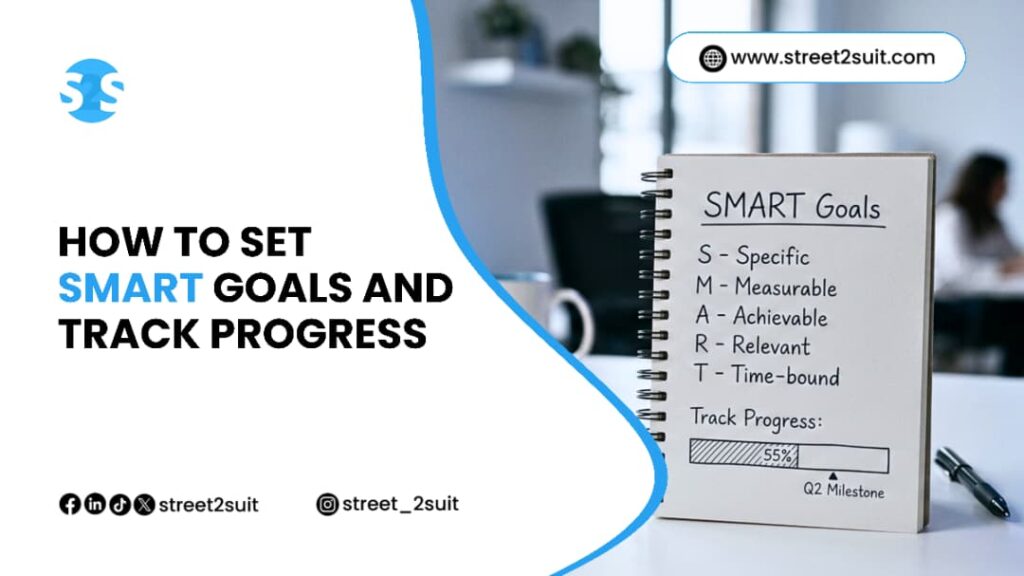
What Are SMART Goals?
SMART is a framework that helps turn “I hope” into “I plan.”
It stands for:
S – Specific
Vague goals create vague results. Instead of saying: “I want to improve my grades.”
Say: “I want to raise my GPA from 3.2 to 3.8 this semester.”
Specific goals reduce confusion. Your brain works better when it knows exactly what it’s aiming at. “Do better” is unclear. “Study 2 hours daily from 7–9pm” is clear.
Your mind likes clarity. It does not like guessing games.
M – Measurable
If you can’t measure it, you can’t track it. And if you can’t track it, you’ll probably forget it. Instead of: “I want to save money.”
Say: “I will save ₦15,000 monthly for the next six months.”
Numbers make progress visible. Research on behavior change shows that monitoring progress increases the likelihood of success because it keeps goals active in your awareness. In simple terms: what gets tracked gets improved.
A – Achievable
If you currently study 30 minutes a day, declaring you’ll study 10 hours daily starting tomorrow is not ambition, its self-sabotage wearing confidence. An achievable goal stretches you without snapping you. For example: “I will increase my study time from 30 minutes to 2 hours daily over the next three weeks.” Growth is progressive. Even muscles don’t grow overnight same as your discipline won’t either.
R – Relevant
Not every impressive goal is your goal. Before committing, ask:
- Does this align with my long-term vision?
- Is this important to me or am I copying trends?
Relevance protects you from unnecessary pressure. It keeps you focused on what truly matters instead of chasing everything that looks productive. If you’re building a career in health, taking a course related to public health or leadership may be more relevant than mastering five random skills at once.
T – Time-bound
Without a deadline, goals become “someday projects.” We all know “someday” is a very comfortable place where dreams quietly retire. Instead of: “I’ll start exercising.” Say: “I will work out three times a week for the next eight weeks.”
Deadlines create urgency. They also help you evaluate progress. If there’s no time frame, there’s no checkpoint.
How to Track Your Progress
Now that you’ve set your SMART goal, how do you avoid abandoning it after week two?
Here’s where discipline becomes practical.
Break It Down Into Small Actions
Big goals can feel intimidating. Smaller tasks feel doable. If your goal is: “Score at least 75% in my next exam.” Your weekly actions might be:
- Revise two topics every week.
- Solve 30 past questions every Saturday.
- Attend all lectures.
Small wins create momentum. And momentum keeps you going.
Write It Down
Studies show that writing down your goals increases the likelihood of achieving them. There’s something psychological about seeing your commitment in ink. You can use:
- A planner
- A notebook
- A wall chart
- Even sticky notes
Your brain takes written goals more seriously than mental promises.
Schedule Weekly Reviews
Once a week, pause and ask yourself:
- What did I complete?
- What slowed me down?
- What needs adjustment?
Tracking is not about perfection. It’s about awareness. If you missed two workouts, don’t cancel the entire plan. Adjust and continue. Progress is not ruined by one bad week, it’s ruined by quitting.
Track Habits, Not Just Results
Results take time. Habits happen daily. If your goal is weight management, track:
- Number of workout sessions.
- Daily water intake.
- Sleep consistency.
Research in behavior science shows that focusing on systems (daily actions) is more sustainable than obsessing over outcomes. The result is the reward. The habit is the work.
Celebrate Progress (Yes, Even Small Ones)
Finished your first consistent week?
Saved your first ₦15,000?
Submitted assignments early for once?
Celebrate it. Not with irresponsibility but with acknowledgment. Progress deserves recognition. Discipline deserves encouragement. Even you deserve encouragement.
SMART goals are not magical formulas. They are structured commitments. They bring clarity to ambition. They bring order to intention. They bring direction to effort.
You don’t need 15 goals at once. Start with one. Make it specific. Make it measurable. Make it realistic. Make it meaningful. Give it a deadline, then track it like it matters. Because it does.
Receive the latest job and career updates in your inbox, every week!

Mariam is an imaginative and meticulous writer who is passionate about crafting compelling narratives and translating concepts into influential content.