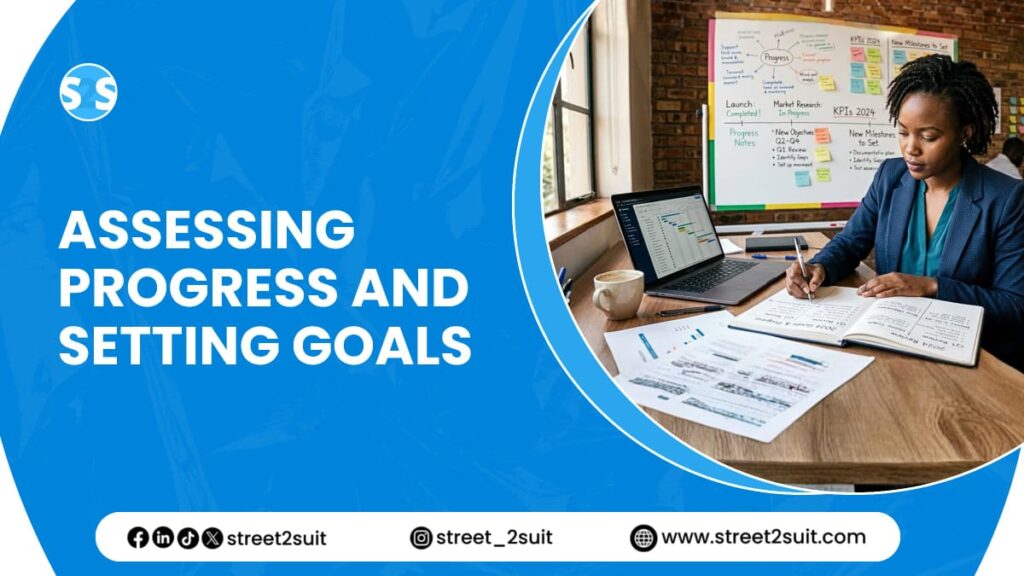
If we are honest, most people love the idea of progress until it is time to actually check whether progress is happening. It feels good to say, “This year will be my year,” but halfway through the year, you suddenly realize your notebook has motivational quotes, unfinished plans, and one list written over your life goals.
That is exactly why assessing progress and setting goals matter. Growth is not just about being busy; it is about knowing whether all that effort is actually taking you somewhere useful. Otherwise, you may be running very fast on what is essentially a treadmill – lots of sweat, no movement.
Why Assessing Progress Matters
Assessing progress simply means stopping long enough to ask yourself: How am I really doing?
Not the polite answer you give when someone asks, “How are things?” but the honest answer.
Have you improved? Have you learned something new? Are you closer to where you wanted to be, or are you still negotiating with deadlines like they are distant relatives who can wait?
The truth is, many people are making progress without noticing it because they are too focused on what is still left to do. Others think they are progressing because they are always busy, but busyness and progress are not twins, they are sometimes just cousins who look alike.
For example, answering fifty emails in one day may feel productive, but if the important project remains untouched, your inbox may be thriving while your actual goals are starving.
Progress Is Not Always Dramatic
One reason people miss progress is because they expect it to arrive like a movie scene with dramatic music, applause, and instant success.
Real progress is often quiet.
It looks like understanding something today that confused you last month, speaking with more confidence than before, spending less time procrastinating, and finally finishing something you kept postponing.
Sometimes progress is simply resisting the urge to quit.
And yes, sometimes progress deserves celebration, even if the achievement is small. If you finally replied to that email you avoided for three days, that is emotional growth too.
Honest Questions That Reveal Real Progress
To assess progress properly, ask questions like:
What have I improved recently?
What still feels difficult?
What habits are helping me?
What habits are pretending to help me while secretly wasting my time?
That last question matters because not every routine deserves loyalty.
Checking your phone every ten minutes is not “staying informed.” Sometimes it is just giving your focus away for free.
Feedback
Sometimes other people notice our growth before we do or notice our weaknesses before we are ready to admit them.
Feedback can feel uncomfortable because nobody enjoys hearing, “You could improve here.” But useful feedback is like a mirror, it may not flatter you every time, but it helps you avoid walking around with toothpaste on your face.
A colleague may tell you that your ideas are strong but your communication needs clarity. That is not criticism to fear, it is information to use.
Why Goal Setting Matters
After assessing progress comes the second important part: setting goals.
Without goals, effort becomes random. You can be hardworking and still directionless, like someone driving very confidently without knowing where the road leads.
Goals give your effort a destination.
Instead of saying you want to improve yourself, take action! Complete a professional course in three months, improve your public speaking skills. Now your brain has something concrete to work with.
Good Goals Need Structure
A useful goal should be:
Specific, Measurable, Achievable, Realistic, Time-bound (SMART)
Why People Set Goals and Then Ignore Them
Sometimes goals fail not because they are impossible, but because life becomes noisy.
You set a goal on Monday. By Wednesday, work happens. By Friday, you are tired. By Sunday, the goal is sitting quietly in your notebook wondering what it did wrong.
This is normal.
That is why goals need systems, not just enthusiasm. A goal without a plan is like buying exercise shoes and expecting fitness to happen automatically. The shoes are innocent. They cannot do the work for you.
Break Big Goals into Smaller Steps
Large goals often look intimidating until they are divided.
Small steps remove fear. Not every month will feel productive. Some periods feel slow, some plans fail, some goals need adjustment.That does not mean progress has stopped, it simply means growth is human.
Conclusion
Assessing progress and setting goals are less about controlling every detail of life and more about staying aware of where you are going.
You do not need to have everything figured out. Most people are learning while pretending they already know what they are doing anyway. The important thing is to keep checking, keep adjusting, and keep moving.
And if you occasionally discover that your biggest achievement this week was simply surviving Monday with dignity, that counts too
Receive the latest job and career updates in your inbox, every week!

Mariam is an imaginative and meticulous writer who is passionate about crafting compelling narratives and translating concepts into influential content.